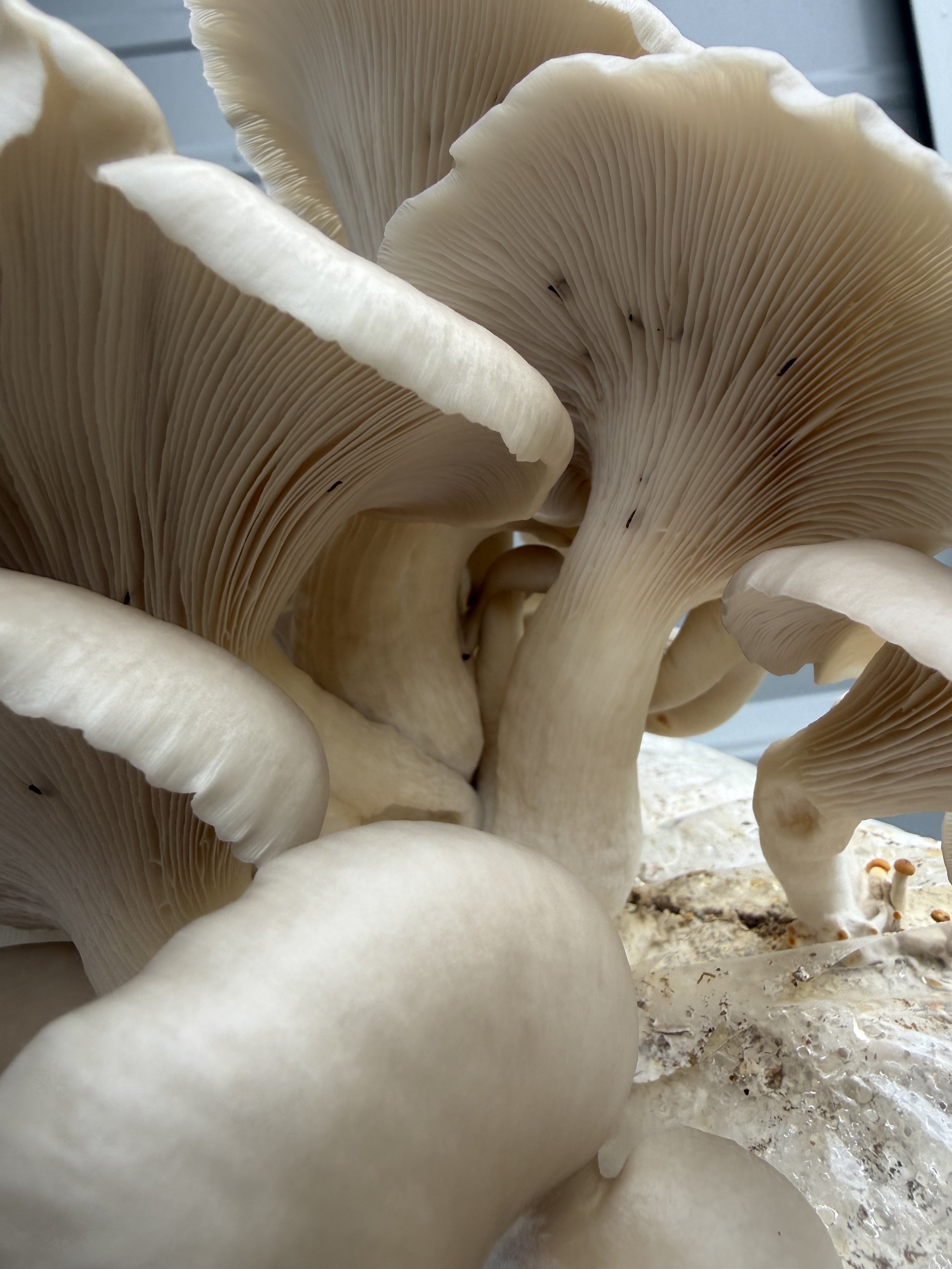
Does Growing Mushrooms Make You a Better Human?
The answer isn't quite that simple.
But in some ways, yes, it absolutely can.
Before you get the wrong idea, I'm not talking about consuming mushrooms in any form. No teas, capsules, tinctures, or creams. I'm talking specifically about the act of cultivating them.
Growing mushrooms teaches lessons that reach far beyond the grow room.
Learning From Nature's Recyclers
Fungi are among the planet's greatest recyclers. Without them, forests would eventually become buried under mountains of dead wood and organic debris. Nutrients would remain locked away, unavailable to new generations of plants, animals, and microorganisms.
Many of the mushrooms we cultivate are saprophytes: fungi that feed on dead organic matter. Through their work, they transform death into more life.
That may just sound poetic, but it carries a profound lesson.
Modern society often treats death as something to fear, avoid, or ignore. It's viewed as an ending rather than a transition. Yet fungi show us a different perspective. Every fallen tree becomes food for new life. Every ending creates the conditions for a new beginning.
When you spend time cultivating mushrooms, you begin to witness this cycle firsthand. Death becomes less of an abstract fear and more of a natural part of life's ongoing process. It encourages you to appreciate the present moment and recognize that what you do today contributes to what comes after you.
Seeing Value Where Others See Waste
Mushrooms are one of the most sustainable crops humans can grow.
They are packed with protein, fiber, vitamins, minerals, and a wide variety of biologically active compounds. Yet they thrive on materials that many industries consider waste: sawdust, agricultural residues, coffee grounds, and other byproducts.
As a cultivator, you begin to see resources differently.
What one person calls waste becomes a substrate. What looks like a discarded material becomes the foundation for food, medicine, and new life.
The lesson doesn't stop there. After harvesting mushrooms, the spent substrate still has value. I often use old mushroom blocks in my garden, where they help improve soil structure, increase water retention, and support beneficial microbial life.
Growing mushrooms trains you to look beyond the surface and ask a simple but powerful question:
"What else could this become?"
That's a mindset that extends far beyond mushroom cultivation.
Patience Can't Be Purchased
We live in a world built around instant gratification.
Mushrooms don't care.
No matter how badly you want a harvest, you can't force mycelium to colonize faster. You can't rush a fruiting cycle. You can't demand results overnight.
You start with a culture. You provide food, water, and the right environment. Then you wait.
And watch.
And learn.
Over the course of days and weeks, the mycelium slowly expands through the substrate. If conditions are right, it thrives. If they're wrong, it tells you. Mushrooms provide remarkably fast feedback compared to many crops, but they still require patience.
Cultivation teaches a valuable lesson: preparation and consistency matter more than urgency.
You learn that meaningful growth often happens out of sight. The work done beneath the surface is what eventually produces visible results.
That's true for mushrooms, and often true for people.
Building Networks Like Mycelium
Fungi are famous for their underground networks.
Although the phrase "wood wide web" is often oversimplified, fungal networks do connect ecosystems in remarkable ways. In cultivation, we watch mycelium spread outward, branch, reconnect, and establish new territory.
Many cultivators end up doing the same thing.
They join communities. They exchange cultures, techniques, ideas, and experiences. They learn that success often comes from collaboration rather than isolation.
A healthy mycelial network is resilient because it is connected.
Human communities work much the same way.
The strongest growers are rarely the ones who know everything. They're the ones willing to learn, teach, and support others while accepting support themselves.
Beyond just people: you’ll become aware of all those in you Community/Ecosystem. From microbe to elephant you can begin to understand and appreciate each role and feel the weight they pull to keep the systems progeessing.
More Than Just Mushrooms
If you've ever cultivated mushrooms, or really any living organism, you've probably discovered lessons of your own.
Growing mushrooms teaches patience, stewardship, observation, sustainability, and respect for natural cycles. It encourages curiosity and rewards consistency. It challenges you to slow down and pay attention.
Will growing mushrooms automatically make you a better human?
No.
But if you're paying attention, it might help you become a more thoughtful one.
And that's a pretty good place to start.