
Cultivating Boletes!
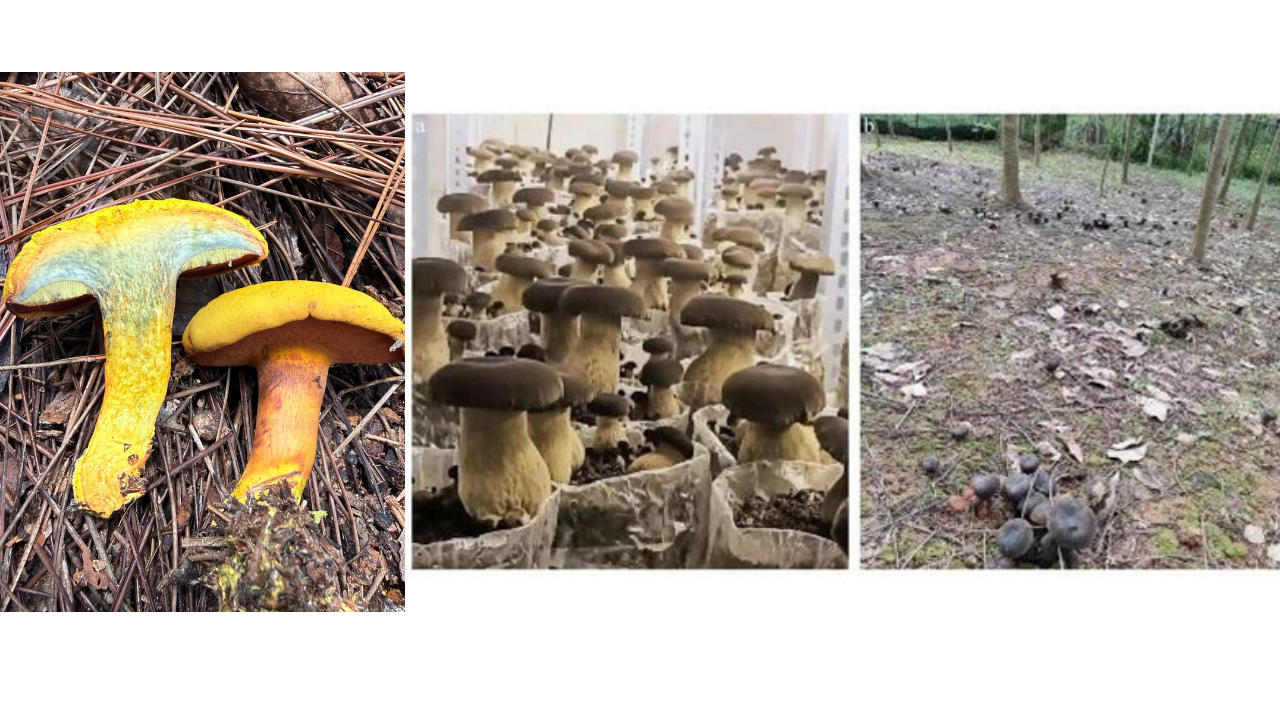
(Left) Buchwaldoboletus (Chalciporus) hemichrysus found in Jackonville, Florida.
(Right/center) Phelebopus portentosus in cultivation and outdoors in Wild.
Cultivating the Unknown
What do you do when you find a mushroom that nobody seems to know how to grow?
You try.
Most mushroom cultivation starts with a recipe. You have your grain, your substrate, your temperature, your humidity, and hopefully somewhere along the way a mushroom appears. For species like oyster mushrooms, Lion's Mane, shiitake, or wine caps, there are decades of accumulated knowledge telling us what generally works.
But what happens when there isn't a recipe or tek to find and easily follow?
That is where things get interesting.
Over the past year I have started collecting and culturing some of the less familiar mushrooms I've encountered here in Florida and with trading with friends. Right now that includes the Black Bolete, Phlebopus portentosus and a strange yellow bolete historically called Buchwaldoboletus hemichrysus and currently treated as Chalciporus hemichrysus, along with a few other boletes whose identities I am still working through.
I don't have a proven cultivation protocol for most of them.
That's kind of the point.
The more I started digging through the literature, though, the more I realized that "unknown" does not always mean "unstudied."
Sometimes somebody has already tried.
Sometimes they got surprisingly far.
And sometimes the research gives us just enough information to start asking better questions ourselves. Not done yet does not mean impossible!
A Bolete That Doesn't Need a Tree?
When most people hear "bolete," they probably think about trees.
And for good reason!
Many familiar boletes are ectomycorrhizal fungi. Their underground mycelium forms relationships with the roots of living plants, exchanging resources with their hosts. The fungus receives carbon from the plant while helping the plant access nutrients and water.
That makes cultivation considerably more complicated than growing an oyster mushroom on a bag of sawdust.
You cannot necessarily isolate a porcini, put it on wood, and wait for mushrooms.
Then there is Phlebopus portentosus.
The black bolete is a tropical and subtropical mushroom that is collected and eaten in parts of Southeast Asia. It has been shown to form ectomycorrhizal relationships with plants, but researchers have also demonstrated something much more surprising: it can produce mushrooms without a living host plant.
In a 2010 study, Sanmee and colleagues isolated P. portentosus from a wild fruiting body in Thailand and successfully produced a mature basidiome on sorghum grain medium without a host plant. The resulting mushroom produced basidiospores, and those spores germinated on agar. The researchers also inoculated five potential host plants and found ectomycorrhizal roots only on Pinus kesiya. They concluded that P. portentosus may be facultatively ectomycorrhizal, meaning that although it can form a relationship with a plant, it is not absolutely dependent upon one to complete its life cycle.
That changes the question completely.
Instead of asking, "What tree do I need to grow this mushroom?"
we can ask:
What nutritional and environmental conditions allow this fungus to complete its life cycle without one?
Fortunately, researchers have already started answering that question.
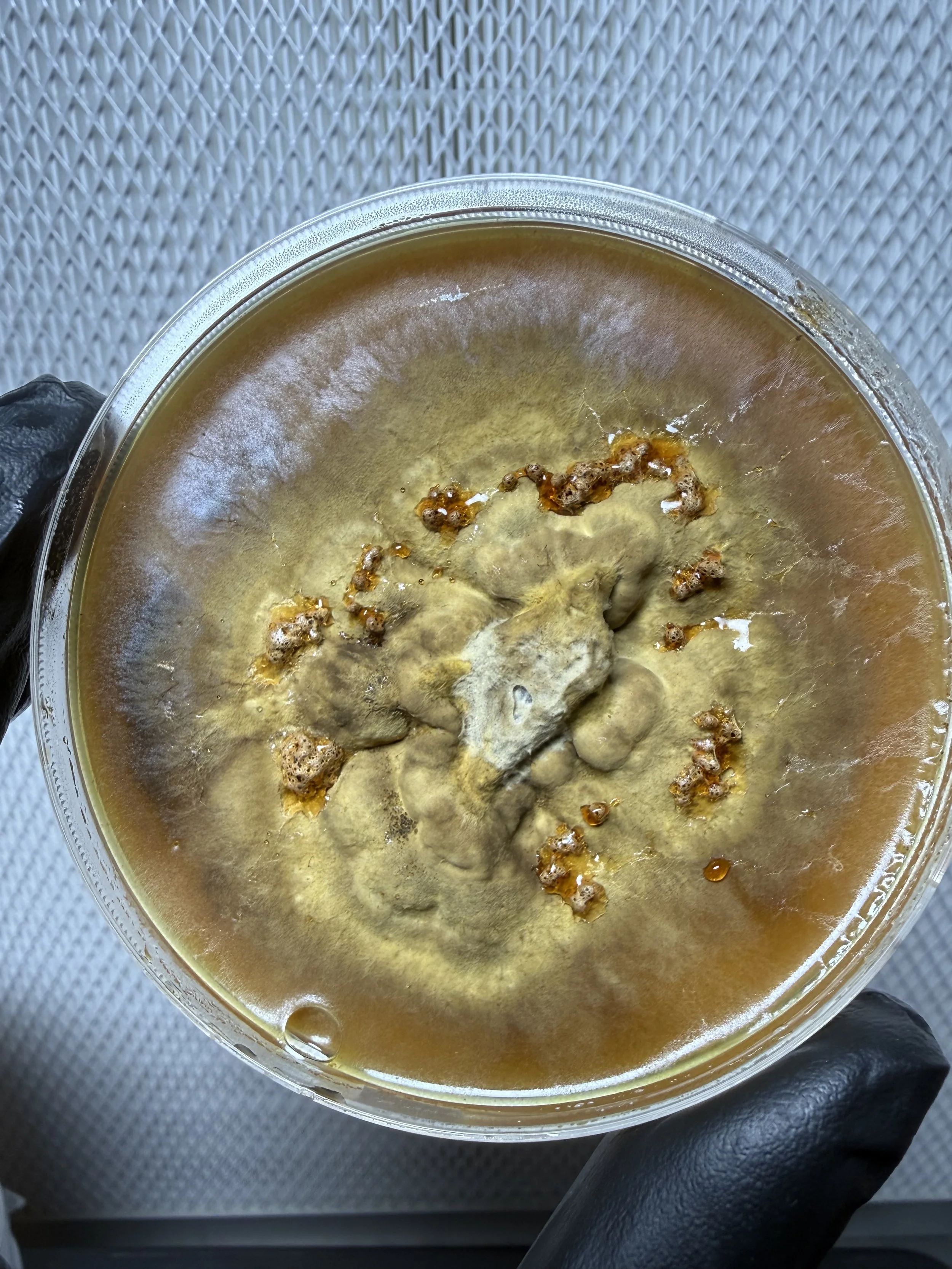
Phlebopus portentosus (the Black Bolete) Mycelium on Agar!
So How Did They Actually Grow It?
This is where P. portentosus gets particularly interesting, because the research goes considerably further than simply proving that it can fruit.
The first stage is establishing strong vegetative growth.
The 2010 study found that P. portentosus grew well on several laboratory media at approximately 30 °C and pH 4. The researchers also tested different grain materials, and sorghum performed particularly well. The fungus was capable of growing on several other grains, but the results were not uniform across substrates.
That gives us our first useful lesson:
The material a fungus grows from in nature is not necessarily the material that produces the fastest mycelial growth in culture.
A wild fungus might fruit from wood, soil, or a living root system while still preferring a very different nutritional environment during its vegetative stage.
A 2012 study by Kumla and colleagues took the work further by testing five strains of P. portentosus. The researchers again found strong growth on sorghum and found that supplementing the sorghum with a fungal host solution, or FH solution, increased mycelial growth. The fungus also produced sclerotia like structures after approximately three weeks of incubation at 30 °C in darkness.
This is important because it separates growing the fungus from fruiting the fungus.
At this point, the researchers were building mature mycelium.
They were not simply waiting for a mushroom to pop out of a jar.
A Research Based Starting Point
If I were reducing the published work into a basic experimental roadmap, it would look something like this:
Mycelial stage: warm conditions around 30 °C and acidic media supported strong growth.
Spawn: sorghum was particularly successful, with supplemented sorghum performing especially well.
Wood substrate: mature spawn was transitioned into a woody substrate.
Colonization: the fungus was allowed to completely colonize that substrate before fruiting conditions were introduced.
Casing: a moist casing layer was applied.
Fruiting: temperature, humidity, light, and moisture conditions were changed.
That is a very different process from simply inoculating a mushroom bag and waiting.
From Grain to Wood
The 2015 cultivation study is where the black bolete research starts looking much more like a real cultivation system.
Researchers used three week old SGFH master spawn and mixed it with Samanea saman sawdust at three different ratios: 1:1, 1:2, and 1:3 spawn to sawdust by volume. The substrates were adjusted to approximately 65% moisture and incubated at 30 °C in darkness.
The difference in colonization time was substantial.
The 1:1 treatment was fully colonized in approximately 85 to 95 days. The 1:2 treatment took around 120 to 135 days, while the 1:3 treatment required approximately 145 to 156 days.
That is slow.
Very slow compared with an oyster mushroom.
But it also tells us something useful. More wood did not automatically make a better substrate. In this experiment, the treatment with the greatest proportion of spawn colonized the fastest.
For somebody experimenting with this species today, that 1:1 treatment would make a useful control.
Not necessarily the final recipe.
A control.
That distinction is important when working with a wild isolate.
The Fungus Needed a Change
Once the substrate was fully colonized, the researchers did not simply leave it at 30 °C and wait.
They changed the environment.
This appears to be one of the critical parts of the cultivation process.
In the 2012 experiments, researchers tested several casing materials, including perlite, pumice, sand, soil, and a 1:1 mixture of peat and vermiculite. Primordia developed in the soil and peat/vermiculite treatments, while the uncased controls did not produce primordia. The peat and vermiculite treatment performed particularly well.
The fruiting environment was also different from the colonization environment.
The cultures were moved away from the warm, dark incubation conditions toward lower temperature, high humidity, and a 12 hour photoperiod. Under the in vitro conditions, primordia developed into mature mushrooms in approximately 8 to 12 days.
In the pot experiments, primordia appeared after approximately 28 to 35 days, with mature basidiomes developing another 6 to 8 days later. The mushrooms were able to release basidiospores, which were then germinated back into mycelial cultures.
That last part is especially cool.
The researchers were not just making a mushroom.
They demonstrated a complete cycle:
culture → mycelium → fruiting body → spores → new culture.
That is cultivation as biological research.
The Yield Could Be Improved Too
The researchers did not stop after getting a mushroom.
They wanted to know whether they could improve production.
The 2015 study found that the 1:1 SGFH to sawdust treatment produced the greatest number of primordia among the tested substrate ratios and the highest average fresh weight in that experiment.
They also compared several supplemental solutions during fruiting.
The water control produced an average fresh yield of approximately 15 grams per bag, while the fungal host solution treatment produced approximately 33 grams per bag. Modified Murashige and Skoog solution and a vitamin solution also increased yield relative to the control, but the fungal host solution performed best.
That is a pretty significant difference.
It does not mean that P. portentosus secretly requires a tree.
It does not mean the FH solution is some universal bolete fruiting formula.
What it tells us is that the nutritional environment associated with a fungal host can influence the reproductive behavior and yield of this fungus.
And that gives us another hypothesis to test.
What Does That Mean for Growing One in Florida?
This is where the published research becomes useful rather than simply interesting.
I am not working with the exact strains used in these Thai experiments. I am also not growing in northern Thailand. I have Florida temperatures, different materials, and a completely different set of environmental conditions and physical constraints.
So I don't want to simply copy the paper and assume it will work just the same here.
I want to find out which parts of the paper actually matter.
Sorghum is an obvious place to start because it has repeatedly supported strong growth. A wood based substrate makes sense because that gives us a second nutritional environment to investigate. Casing deserves serious attention because the published experiments repeatedly associate casing with primordium formation.
And the environmental transition may be the most interesting part of all.
The research shows successful fruiting under controlled conditions around 25 °C, but the greenhouse experiments also produced mushrooms at substantially warmer temperatures, roughly 27 to 37 °C.
For Florida, that raises an interesting possibility.
Maybe the exact fruiting temperature is less important than the change in conditions.
Maybe the fungus needs to experience a transition from warm, dark, colonizing conditions into a different combination of light, moisture, humidity, and temperature.
That is something I want to investigate.
Then I Found a Bolete That Plays by Different Rules
My Phlebopus project at least comes with a research trail.
The Florida Buchwaldoboletus is another story.
The mushroom I have been calling Buchwaldoboletus hemichrysus has gone through several names over its history. The current name recognized by Species Fungorum and Index Fungorum is Chalciporus hemichrysus, with Buchwaldoboletus hemichrysus retained as a synonym. This changed from Buchwaldoboletus to Chalciporus in 2022.
Taxonomy aside, the ecology is what caught my attention.
Members of this group are associated with wood, and research using southeastern United States collections has shown that Buchwaldoboletus can be much more complicated than the simple label of "wood decomposer" suggests.
A study examining B. hemichrysus, B. lignicola, and B. sphaerocephalus found evidence for what the authors describe as a dual trophic mode, with these fungi capable of saprotrophic and mycoparasitic behavior. Confrontation experiments suggested that Buchwaldoboletus species could attack a range of decay fungi. At the same time, B. hemichrysus and B. lignicola were able to decay wood when grown alone, producing approximately 35 to 65% wood mass loss over six months in the study's wood decay experiments.
That is a very different starting point from Phlebopus.
Instead of asking:
What tree does this bolete need?
we can start asking:
What kind of wood does it use, and what other fungi might it interact with along the way?
That opens up a much more interesting cultivation experiment.
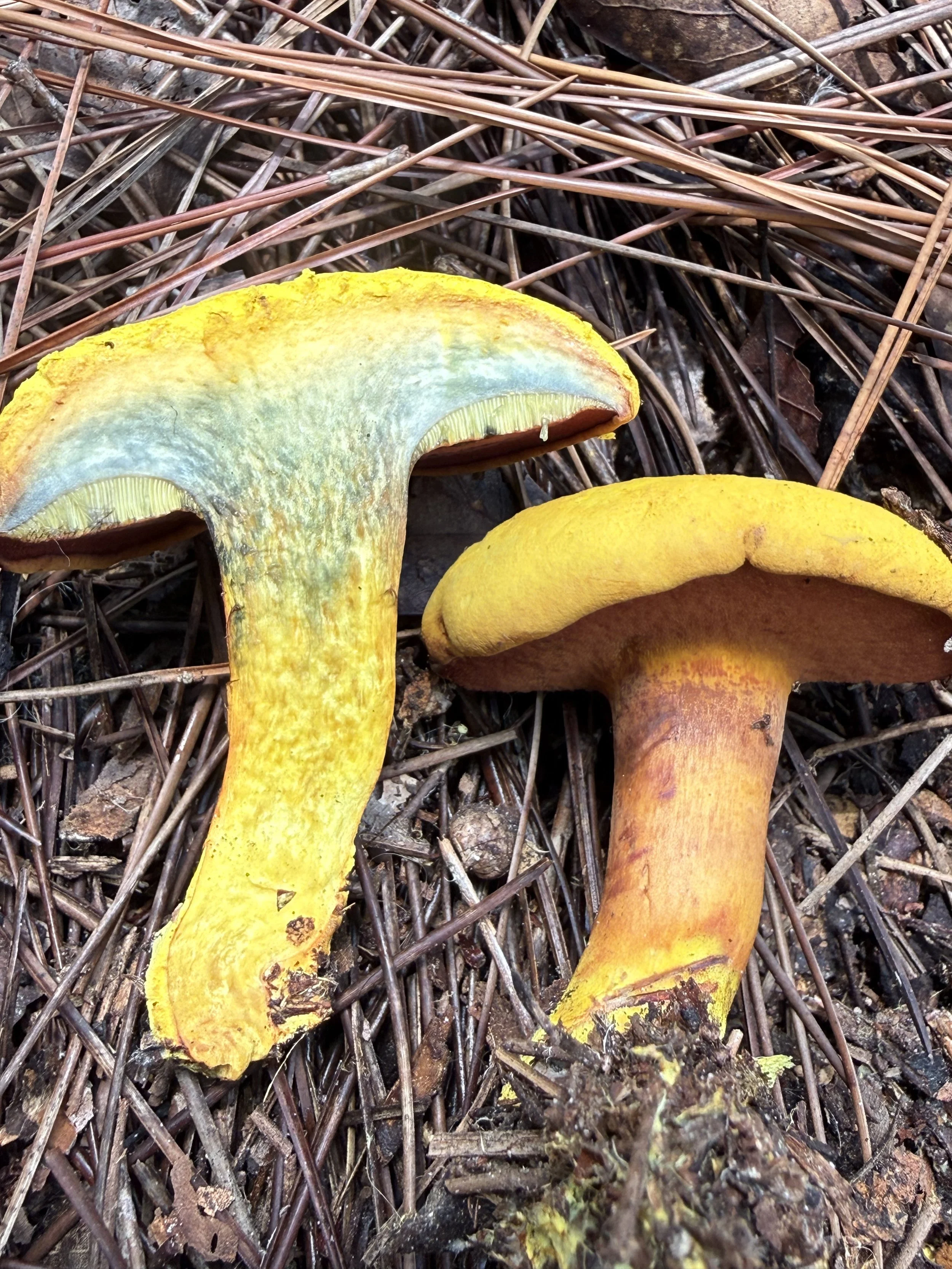
Wild Buchwaldoboletus/Chalciporus hemichrysus specimen found in Jacksonville, Florida.
And Then Someone Actually Grew One
While looking into B. hemichrysus, I came across a 2025 study that made the project considerably more interesting.
Researchers in Southwest China reported the first artificial cultivation of Buchwaldoboletus xylophilus in a mushroom house. They isolated the fungus from wild material, studied its nutritional requirements, developed a cultivation substrate, and eventually produced mature mushrooms without a living host plant.
They found that B. xylophilus grew particularly well around 28 °C, with a preferred pH range of approximately 5 to 6. In their nutritional experiments, maltose performed well as a carbon source, ammonium tartrate as a nitrogen source, and magnesium sulfate as an inorganic salt. Their broader optimization experiments also identified combinations involving dextrose, ammonium nitrate, and potassium dihydrogen phosphate.
Then they moved into actual cultivation.
Their fruiting substrate contained:
40% rubber sawdust
35% rubber wood pieces
15% bagasse
8% corn flour
1% sucrose
1% calcium carbonate
The substrate was adjusted to approximately 60 to 65% moisture, sterilized, and inoculated with liquid culture. The bags were incubated at 28 °C in darkness. The fungus colonized the bags in approximately 50 days.
Then came the fruiting stage.
The fully colonized bags were covered with a 3 to 4 cm casing layer made from peat and garden soil at a 1:1 ratio. The cased bags were maintained around 28 to 30 °C and 80 to 85% relative humidity. Once primordia formed, conditions were adjusted to approximately 27 to 29 °C with around 1000 lux and a 12 hour light cycle. Primordia appeared approximately 9 to 14 days after casing, and mature mushrooms developed another 6 to 8 days later.
The average yield was approximately 131 grams of fresh mushrooms per bag, with a reported biological efficiency of approximately 28.5%. The cultivated mushrooms were also confirmed using morphological and molecular methods.
That is not somebody getting a bolete to grow on agar.
That is a wild bolete being taken through isolation, cultivation, substrate colonization, casing, fruiting, harvest, and identification.
Someone actually grew the mushroom.
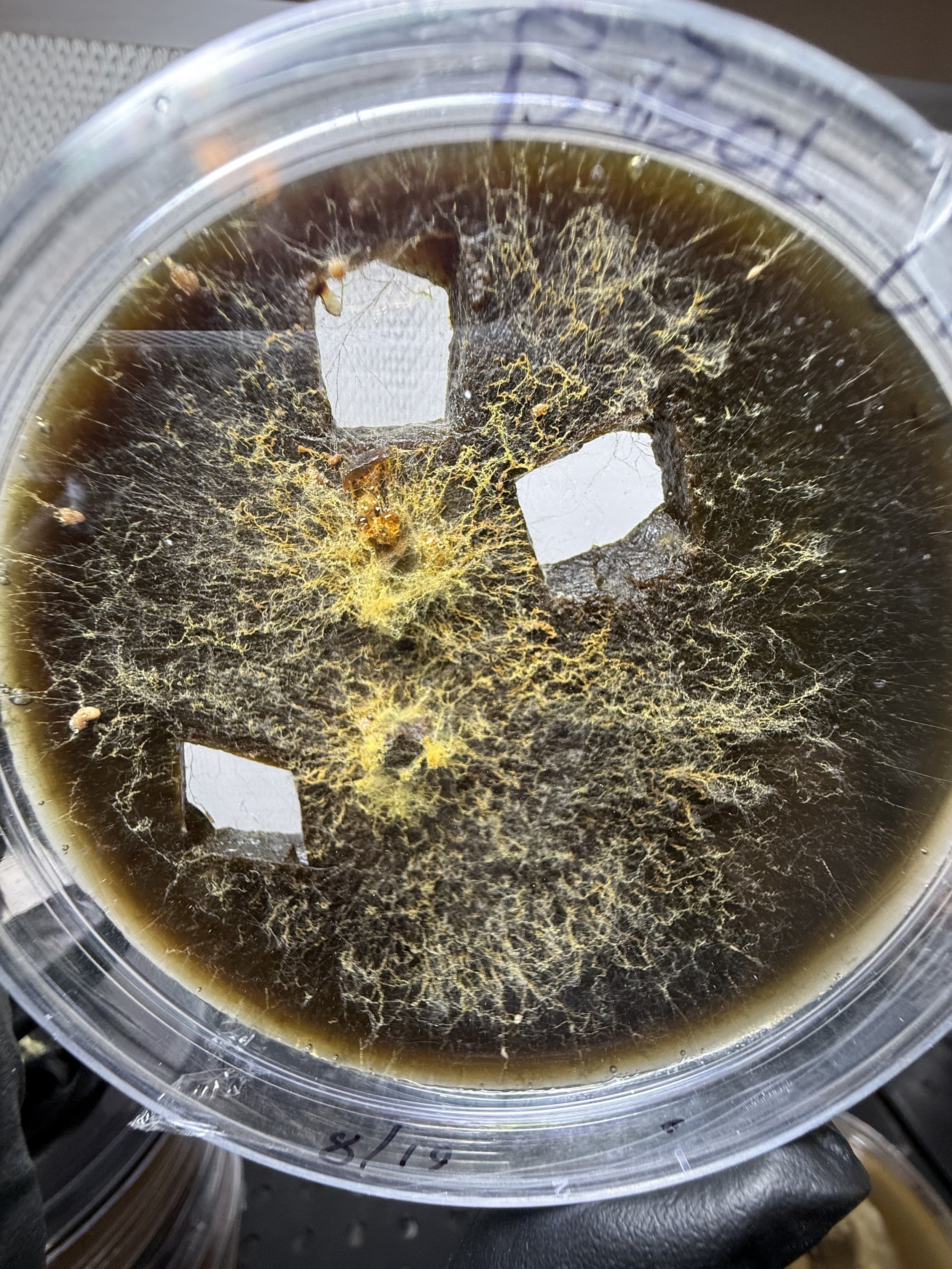
The Half Yellow Powdery Bolete (Buchwaldoboletus/Chalciporus hemichrysus) Mycelium on Charcoal Agar!
So Can We Do the Same Thing?
Not necessarily.
And that is important.
B. xylophilus is not C. hemichrysus. A successful substrate for one species does not automatically become a successful substrate for another.
But it gives us something much better than a guess.
It gives us a hypothesis.
We know that B. xylophilus can fruit on a woody substrate.
We know that C. hemichrysus has demonstrated the ability to decay wood.
We know that members of this group can interact with other fungi.
We know that wood based cultivation can support at least one member of the group all the way through fruiting.
What we don't know is exactly what C. hemichrysus requires.
And that gap is where the experiment starts.
I would want to compare hardwood and pine based materials, different levels of supplementation, and perhaps even wood that has already undergone some degree of fungal decomposition.
That last one is particularly interesting.
If Buchwaldoboletus can attack other wood decay fungi, perhaps the fungus is not simply using wood as a food source. Perhaps it is exploiting resources created by other organisms.
That gives us a completely different model:
wood → decomposer → Buchwaldoboletus
instead of simply:
wood → Buchwaldoboletus
We don't know if that is actually what happens.
But we can test it.
And There Are More
These aren't the only boletes I'm interested in.
I also have cultures that may represent the bicolor bolete, Baorangia bicolor, and another that may be Boletus oliveisporus. With both, identification is still something I want to be cautious about, because bolete taxonomy has changed dramatically as molecular data have become available.
And these mushrooms bring us back to another major question.
Not every bolete should be cultivated the same way.
If an isolate turns out to be strongly ectomycorrhizal, a bag of supplemented sawdust may not be the most meaningful experiment. A living host plant may be the more appropriate system.
That could mean growing a pine seedling, inoculating its roots, confirming colonization, and then asking whether the fungus can eventually progress toward fruiting.
That is a much longer project.
It may fail.
But even that failure could be informative.
If the fungus colonizes the roots but never fruits, we have learned that root colonization and reproduction are separate problems. If it will not colonize the host at all, then perhaps the host, isolate, or conditions are wrong.
The experiment has to follow the fungus.
Cultivation Is More Than Growing Mushrooms
The more I work with these fungi, the more I think cultivation is really another way of doing ecology.
We can ask what a fungus eats.
We can ask what temperatures it tolerates.
We can see whether it needs a living plant.
We can introduce another fungus and see what happens.
We can change the moisture, light, temperature, or substrate and watch how the organism responds.
Eventually, we might get a mushroom.
But even if we don't, we've learned something about the organism.
That is what makes cultivating the unknown so interesting to me.
A substrate experiment can tell us something about what a fungus can digest. A temperature experiment can tell us something about its environmental range. A host plant experiment can tell us something about symbiosis. A confrontation experiment can tell us something about fungal interactions.
And a failed fruiting attempt can tell us that something important is missing.
Failure isn't necessarily the end of the experiment.
Sometimes it is the result that tells you what question to ask next.
Start With What We Know
I don't want this project to become a collection of wild guesses disguised as cultivation advice.
There is already enough of that in mycology.
With Phlebopus portentosus, we have published evidence showing that a fungus capable of forming ectomycorrhizae can also complete its life cycle without a host, along with experimental information about grain spawn, woody substrates, casing, temperature, humidity, light, supplementation, and fruiting.
With Buchwaldoboletus xylophilus, we have a recent example of a wild bolete being taken from isolation all the way through artificial cultivation and fruiting on a woody substrate.
With Chalciporus hemichrysus, we have evidence of wood decay and evidence that members of this group can exhibit both saprotrophic and mycoparasitic behavior.
With some of the other boletes I'm working with, the evidence gets much thinner.
And that's okay.
We just need to be honest about where the line is between what we know, what we suspect, and what we're testing.
That line is where good cultivation work begins.
Cultivate the Unknown
There are thousands of mushrooms around us that we know how to identify but don't know how to cultivate.
There are others we barely understand at all.
Some may never become cultivated crops. Some may require a living tree, another fungus, a particular soil, or environmental conditions we haven't figured out yet.
But somewhere in that enormous unknown are organisms that are going to surprise us.
Maybe one of them is growing on a stump in Florida.
Maybe it's a bolete.
Maybe it's sitting in a culture dish on my desk right now.
I don't know yet.
I'm going to find out.
A Note on Cultivating Wild Fungi
Cultivation and identification are two different problems.
A mushroom growing successfully in a jar does not make it edible, safe, correctly identified, or appropriate for consumption. Wild cultures should be treated as research material until their identity and characteristics are well established.
For these projects, the goal is understanding the organism first.
The mushroom comes later.
References
Sanmee, R., Lumyong, P., Dell, B. & Lumyong, S. (2010). “In vitro cultivation and fruit body formation of the black bolete, Phlebopus portentosus, a popular edible ectomycorrhizal fungus in Thailand.” Mycoscience 51: 15–22.
Kumla, J., Bussaban, B., Suwannarach, N., Lumyong, S. & Danell, E. (2012). “Basidiome formation of an edible wild, putatively ectomycorrhizal fungus, Phlebopus portentosus, without host plant.” Mycologia 104: 597–603.
Kumla et al. (2015). “Improvement of yield for a tropical black bolete, Phlebopus portentosus, cultivation in northern Thailand.” Mycoscience 56: 114–117.
Yang, T. et al. (2025). “First Report on the Artificial Cultivation Techniques of Buchwaldoboletus xylophilus (Boletales, Boletaceae, Buchwaldoboletus) in Southwest China.” Journal of Fungi 11:172.
Polyphyly, asexual reproduction and dual trophic mode in Buchwaldoboletus. Research examining southeastern United States collections of B. hemichrysus, B. lignicola, and B. sphaerocephalus, including wood decay and mycoparasitic interactions.
