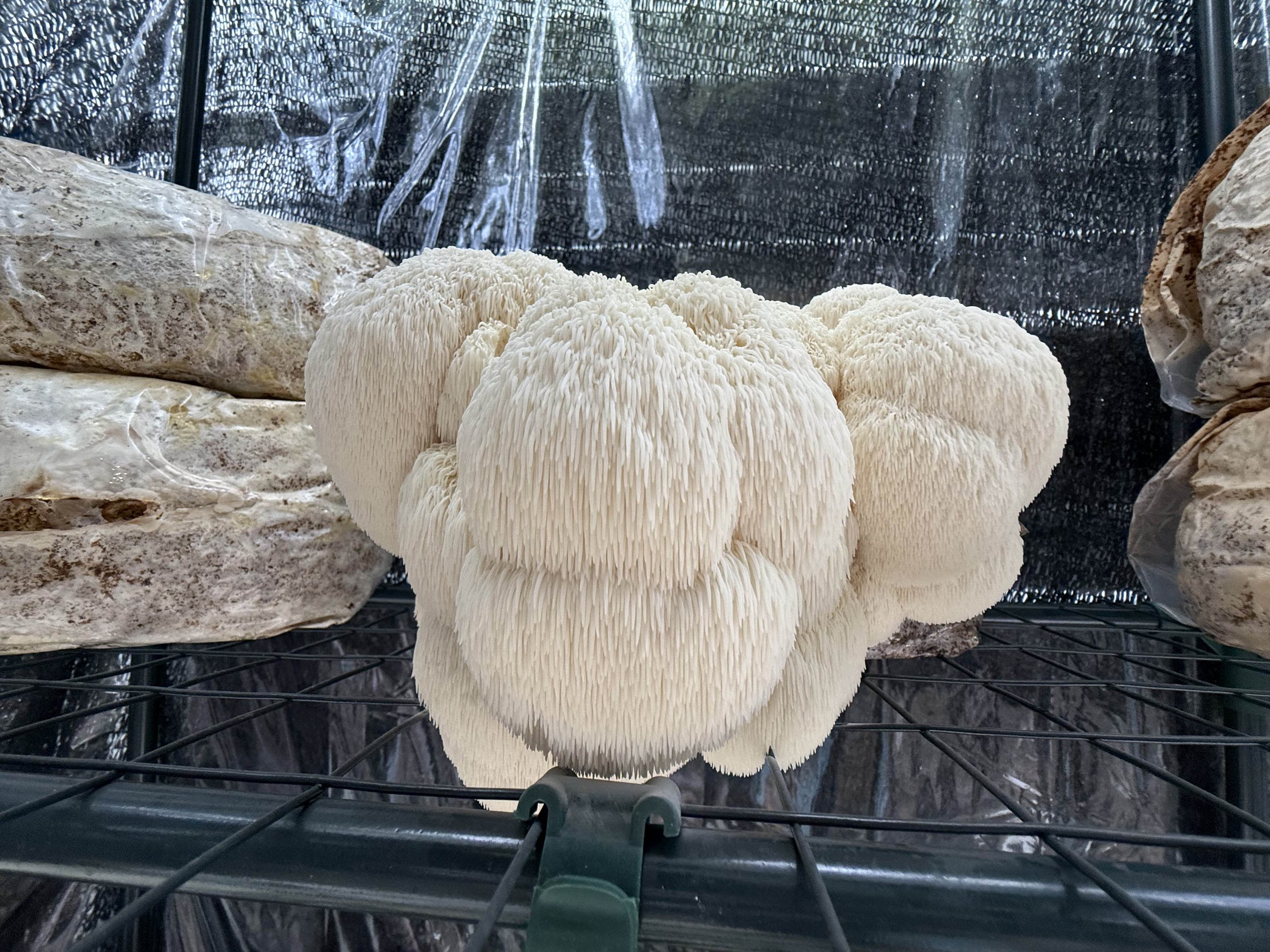
How to Grow lions Mane Mushrooms at Home
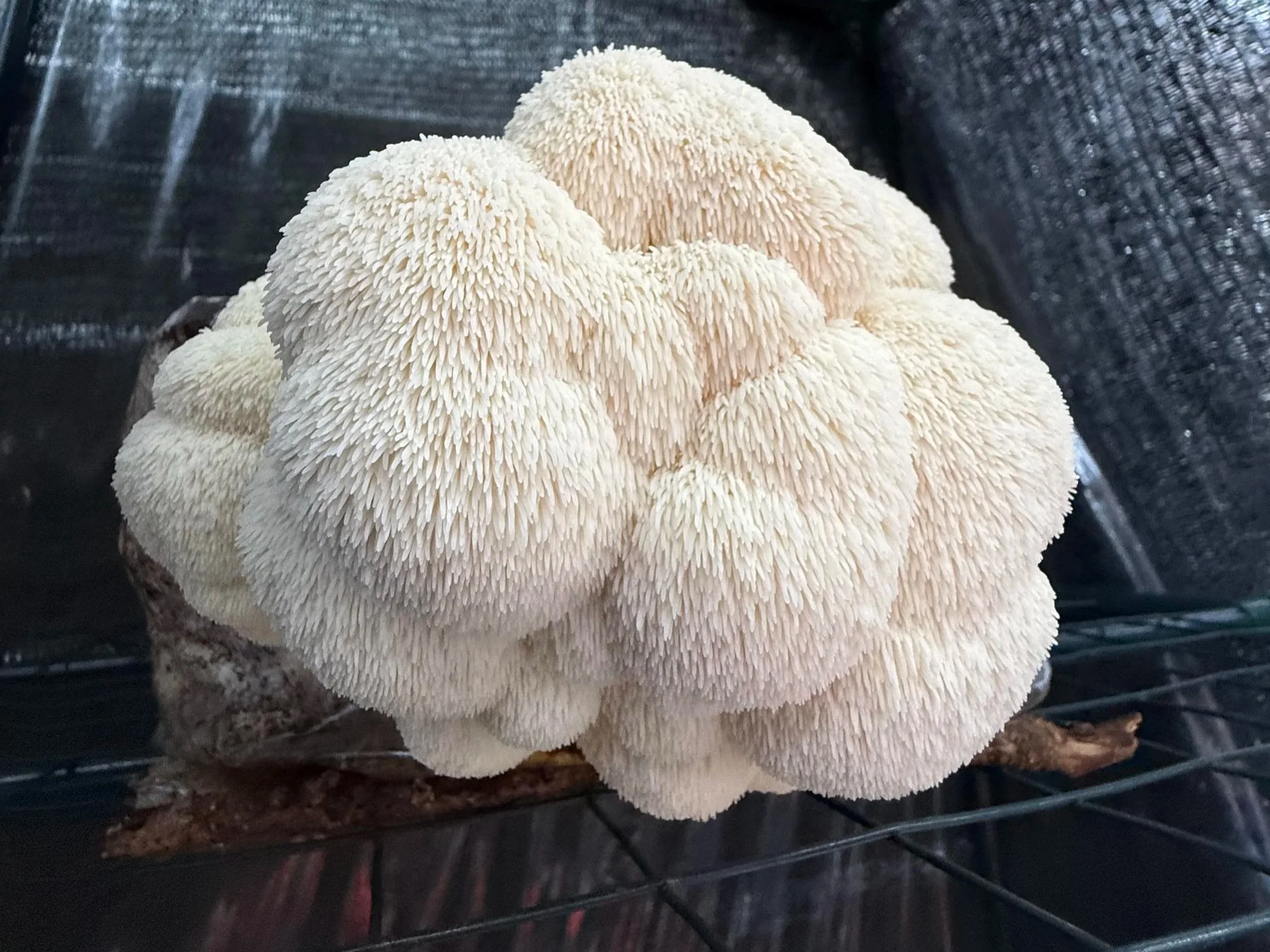
Lion’s Mane is one of my favorite mushrooms to grow.
It is also one of those mushrooms that looks much more complicated than it really is.
If you have ever seen a big Lion’s Mane fruiting from a hardwood log or watched one form into a dense white ball of teeth on a grow block, you might assume there is some complicated trick to getting it there. There really isn’t. Like most mushrooms, the trick is learning what the fungus actually needs and then giving it a reasonable environment to do its thing.
Lion’s Mane, Hericium erinaceus, is a wood decomposer. In cultivation, that usually means growing the mycelium through a hardwood based substrate before giving it the conditions it needs to produce a fruiting body.
There are a few different ways to get started.
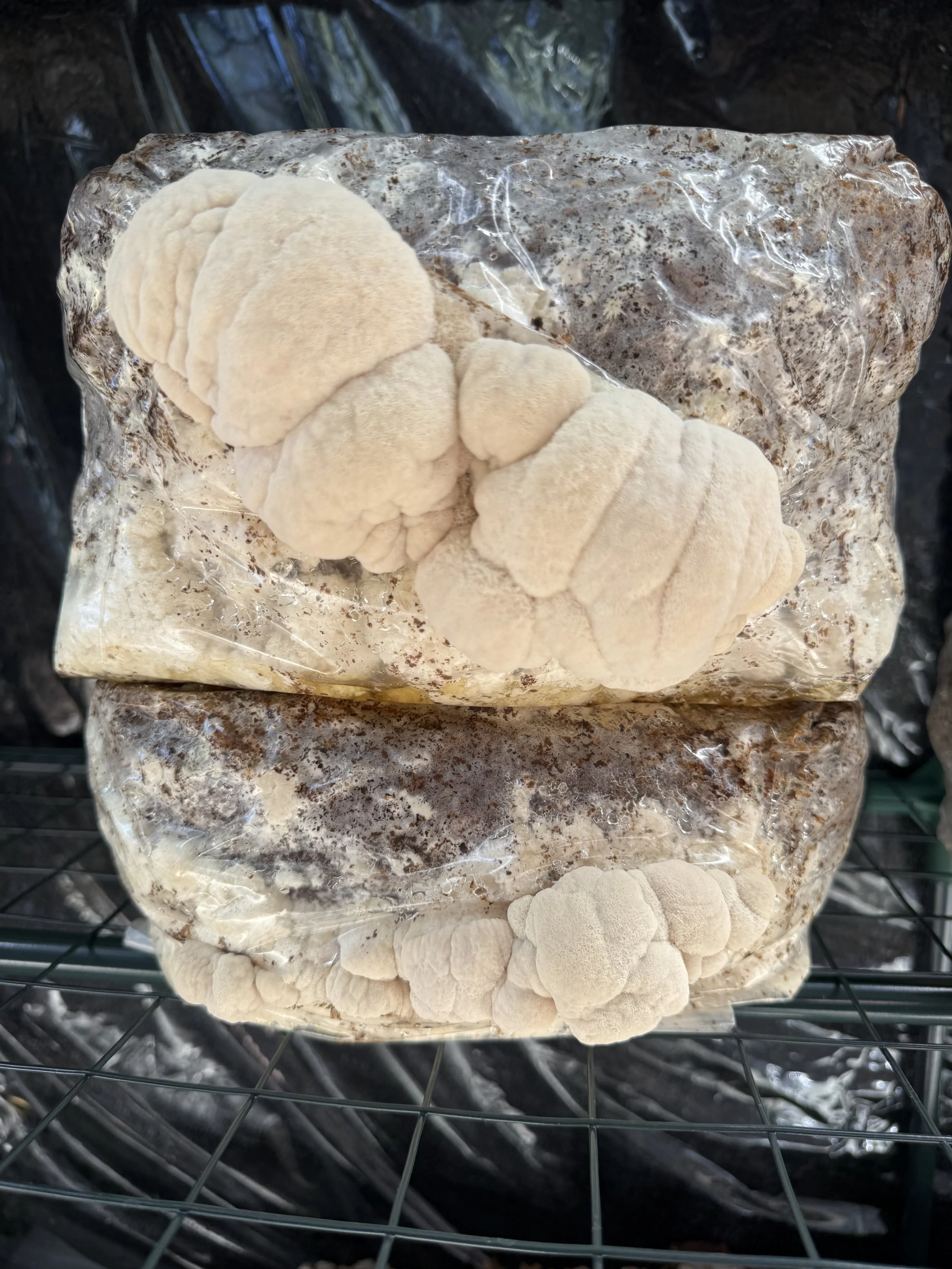
If you are completely new to growing mushrooms, a ready to fruit block is probably the easiest place to start. These are already colonized blocks of mushroom substrate that have done most of the work for you. You simply provide the right fruiting conditions and watch the mushroom develop.
You can sometimes find Lion’s Mane ready to fruit blocks from Swamp Fox Fungi, at local markets, workshops, or from other small growers. I like this starting point because you get to actually watch the mushroom grow before worrying about agar, grain spawn, sterilization, or substrate preparation.
Once you get hooked, though, there is a whole rabbit hole waiting behind that block.
You can buy grain spawn and make your own fruiting blocks. You can prepare your own grain spawn from a culture. Eventually, you can even start working from agar and maintain your own cultures.
This article is meant to help you understand that whole path.
1. Start With a Lion’s Mane Ready to Fruit Block
For someone who has never grown a mushroom before, I would not start with a pressure cooker and a bag of grain.
Start by growing the mushroom. All you do with these is slice, and watch! (And set up humid area if really dry)
A ready to fruit block gives you a chance to learn the part of mushroom cultivation that people actually see. You learn how humidity affects the fruiting body, what fresh air does, how quickly pins develop, what a healthy mushroom looks like, when to harvest, and what happens after the first flush.
Lion’s Mane is particularly fun to watch because the mushroom changes dramatically as it develops.
A small white pin can turn into a dense cluster of spines in only a few days. Those spines elongate as the mushroom matures, and changes in humidity, airflow and temperature can show up directly in the shape and texture of the fruiting body.
For a first grow, you do not need a laboratory.
You need a clean block, somewhere reasonably humid, fresh air, indirect light, and patience. Then, slice the block with one X or —- and boom!
Once you have successfully fruited one block, the next question usually becomes:
How did they make this thing?
That is where cultivation gets interesting.
2. What Does Lion’s Mane Need to Fruit?
Before we talk about recipes, it helps to understand what we are actually trying to accomplish.
There are really two different stages happening.
Colonization is when the Lion’s Mane mycelium grows through and consumes the substrate.
Fruiting is when that established mycelium shifts toward producing a mushroom.
Those stages overlap, but they are not exactly the same job.
During colonization, the fungus is primarily concerned with finding food, breaking it down and building biomass. During fruiting, environmental signals become much more important. Temperature, humidity, oxygen, carbon dioxide, light and moisture all begin influencing what the mushroom does.
This is a transition where environmental conditions such as temperature, humidity, light and airflow are changed or adjusted to encourage fruiting.
For Lion’s Mane, a few things are particularly important.
Temperature
Most cultivation references put Lion’s Mane fruiting somewhere around the 60s to 70s°F, with warmer conditions sometimes tolerated depending on the culture.
A 2022 study reviewing Hericium cultivation parameters reported general fruiting ranges around 18 to 24°C, roughly 64 to 75°F, while mycelial growth is commonly strongest around 21 to 25°C, roughly 70 to 77°F.
That is a useful starting point.
It is not a universal law.
This is where things get interesting.
Different cultures can behave very differently, even within the same species. That is something I have been paying much more attention to as I work with different Lion’s Mane cultures here in Florida. I’ve pushed up to 100°F producing Manes!
Humidity
Lion’s Mane likes a humid fruiting environment, particularly while pins are forming.
You want enough humidity that the developing mushroom does not dry out, but not so much stagnant moisture that the fruiting surface stays constantly wet.
There is a difference between high humidity and being wet.
A humid environment helps the mushroom retain water. Standing water on the mushroom or substrate is a different problem.
Fresh Air
Lion’s Mane needs fresh air exchange during fruiting.
One of the easiest ways to recognize a problem is to look at the mushroom itself.
The shape, spine development and overall structure of the fruiting body can tell you a lot about what is happening in the growing environment. Fruiting is not simply a matter of hitting one perfect number, and growers need to observe the mushrooms and adjust conditions accordingly.
If the mushroom is growing strangely, do not immediately assume the culture is bad.
Look at the environment.
Spongey Lions Mane can be from Humidity or CO2 build up
Early browning? Likely Drying out
Light
Lion’s Mane does not need intense light to produce a mushroom.
A normal indirect light cycle is generally enough to help provide environmental cues and allow you to see what is happening. You are growing a fungus, not a tomato.
3. What Does Lion’s Mane Actually Eat?
This is the part I think gets overlooked when people talk about mushroom cultivation.
Lion’s Mane is not really "eating sawdust."
It is using its enzymes to break down the complex organic material contained within wood.
In nature, Hericium species are wood decomposers and are associated with decaying hardwood. Lion’s Mane and related Hericium species are saprophytic fungi that decompose wood.
When we cultivate them indoors, we are essentially trying to build a controlled version of that food source.
A common Lion’s Mane substrate is therefore based around hardwood sawdust or hardwood fuel pellets.
The hardwood provides the primary carbon rich food source.
Then we can add a smaller amount of a nitrogen rich supplement such as wheat bran.
This gives the fungus a more nutrient dense substrate than plain hardwood alone.
Research on H. erinaceus has also demonstrated that substrate composition matters. One study found oak sawdust supplemented with 10 to 20% rice bran supported strong mycelial growth, while other research has examined different carbon sources, nitrogen sources and agricultural substrates.
This is where understanding the basic idea is more useful than memorizing one magic recipe.
Hardwood provides the structural carbon source.
Supplementation provides additional nutrients.
Water makes those materials biologically available.
The fungus does the rest.
Going Deeper: Making Your Own Lion’s Mane Substrate
If you want to move beyond ready to fruit blocks, this is where you can start making your own.
One of the recipes I use at Swamp Fox Fungi is:
SFF Hardwood Block
5 cups hardwood fuel pellets
1.25 cups wheat bran
1.4 liters water
The wheat bran works out to roughly 20% of the dry material by volume.
The pellets provide the hardwood base while the wheat bran increases the available nitrogen and other nutrients.
The important part is not just throwing those ingredients together.
You need the final substrate to have the right moisture content, structure and cleanliness. Too wet and you create a very different environment than the fungus wants. Too dry and the mycelium runs out of accessible water.
Then this needs to be sterilized at 15PSi for 2.5-3 hours, or lesser nutritional substrates can be pasteurized then used asap with heavier grain spawn ratios.
That page is also where I will keep adding and updating recipes as I continue testing them.
From Substrate to Spawn
There is another step between a mushroom culture and a fully colonized fruiting block.
That step is grain spawn. Starting out; this can be purchased through places with labs that do culture work and can provide the sterile work so you can focus on just growing the mushrooms!
Grain spawn is essentially a nutrient dense carrier that allows you to take a relatively small amount of healthy mushroom culture and use it to inoculate a much larger quantity of substrate.
The basic progression looks something like this:
Culture → Grain Spawn → Fruiting Substrate → Mushroom
Agar can be used to establish and clean up a culture.
That culture can then be transferred to prepared grain.
Once the grain is fully colonized, it can be broken up and mixed into a properly prepared hardwood substrate.
The mycelium then grows outward from those individual grain kernels and colonizes the larger block.
This is one reason grain works so well as spawn. You are creating thousands of little inoculation points throughout the substrate rather than asking the mycelium to grow from one small location.
If you want to make your own Lion’s Mane grain spawn, check out the Grain Spawn Preparation guide in the SFF SOPs & Recipes section.
And if you want to go another step backward, you can learn how to establish and maintain your own cultures on agar.
That is where mushroom cultivation starts turning into mycology.
How Long Does Lion’s Mane Take to Grow?
There is not one universal timeline.
Your culture, spawn rate, substrate, temperature and growing environment can all change the timeline.
As a rough starting point, a healthy Lion’s Mane culture can colonize a supplemented hardwood block over the course of a few weeks. Once the block is ready and fruiting conditions are provided, pins may begin forming relatively quickly, followed by several days of fruit development.
I’d put colonization around two to three weeks followed by another week or two for pinning and fruit development, although real world results vary.
I would rather give you that range than tell you:
Day 14: do this.
Day 17: do this.
Day 21: harvest.
Mushrooms did not read the calendar.
Watch the block.
A fully colonized block should look and behave like an established organism rather than simply following a schedule.
Swamp Fox Field Notes: Genetics Matter
This is where I want to add something you probably will not see in a lot of beginner Lion’s Mane growing guides.
The species name is not the whole story.
If you buy two different Hericium erinaceus cultures, you are not necessarily getting the exact same growing behavior.
They can differ in growth rate, fruiting temperature, morphology, density, spine length, pinning behavior and how they respond to environmental stress.
I have been seeing this firsthand while growing different Lion’s Mane cultures in Florida.
One culture I call June Cut has been cultivated into temperatures in the 100s°F.
Other cultures, including Black Marsh and Virginia Mane, have been cultivated into the mid to high 90s°F.
That does not mean I recommend putting every Lion’s Mane block outside in 100°F Florida weather.
Please do not take that lesson from this article.
Those are observations from particular cultures under particular conditions. They are experiments, not a new universal fruiting temperature for Hericium erinaceus.
The useful lesson is that genetics matter.
A culture selected from a cooler climate may behave differently from one that has already demonstrated some tolerance to heat. Even cultures that are technically the same species can respond differently when you change the environment.
That is one reason I keep the SFF Culture Rundown available. It is where I document cultures I have worked with, where they came from, how they have behaved here in the Swamp, and what I am learning from them.
It is also part of a bigger lesson in mycology.
Spores introduce genetic diversity.
Cloning preserves a particular individual.
Cultures can carry traits that are useful in one environment and frustrating in another.
The more mushrooms you grow, the harder it becomes to think of a species as one single predictable organism.
There is still a lot we do not know.
That is part of what makes growing them interesting.
So How Should You Start?
If all of this sounds like a lot, start with a ready to fruit block.
Grow the mushroom.
Learn what healthy fruiting looks like.
Then, if you want to go deeper, buy some grain spawn and make your own blocks.
After that, learn how to prepare your own grain spawn.
Then learn agar.
Eventually you can start selecting cultures, comparing genetics and keeping records of what actually performs in your environment.
You do not have to jump straight into the deep end.
The goal is to build your understanding one step at a time.
For me, that is what makes growing mushrooms so interesting. You start with something as simple as a white ball of Lion’s Mane on a block of hardwood and eventually find yourself asking questions about fungal genetics, enzymes, ecology, substrate chemistry and why one culture can handle conditions that another absolutely hates.
And there is always another question waiting behind that one.
If you want to learn more about Lion’s Mane itself, check out the Swamp Fox Fungi Lion’s Mane Species Spotlight.
For specific cultivation procedures, recipes and grain spawn preparation, check the SOPs & Recipes section.
And if you want to see what different cultures actually do in the real world, take a look through the Culture Rundown.
That is where the growing gets a little more swampy.