Mushroom Fruiting Conditions in Florida: Why the Standard Rules Don't Apply
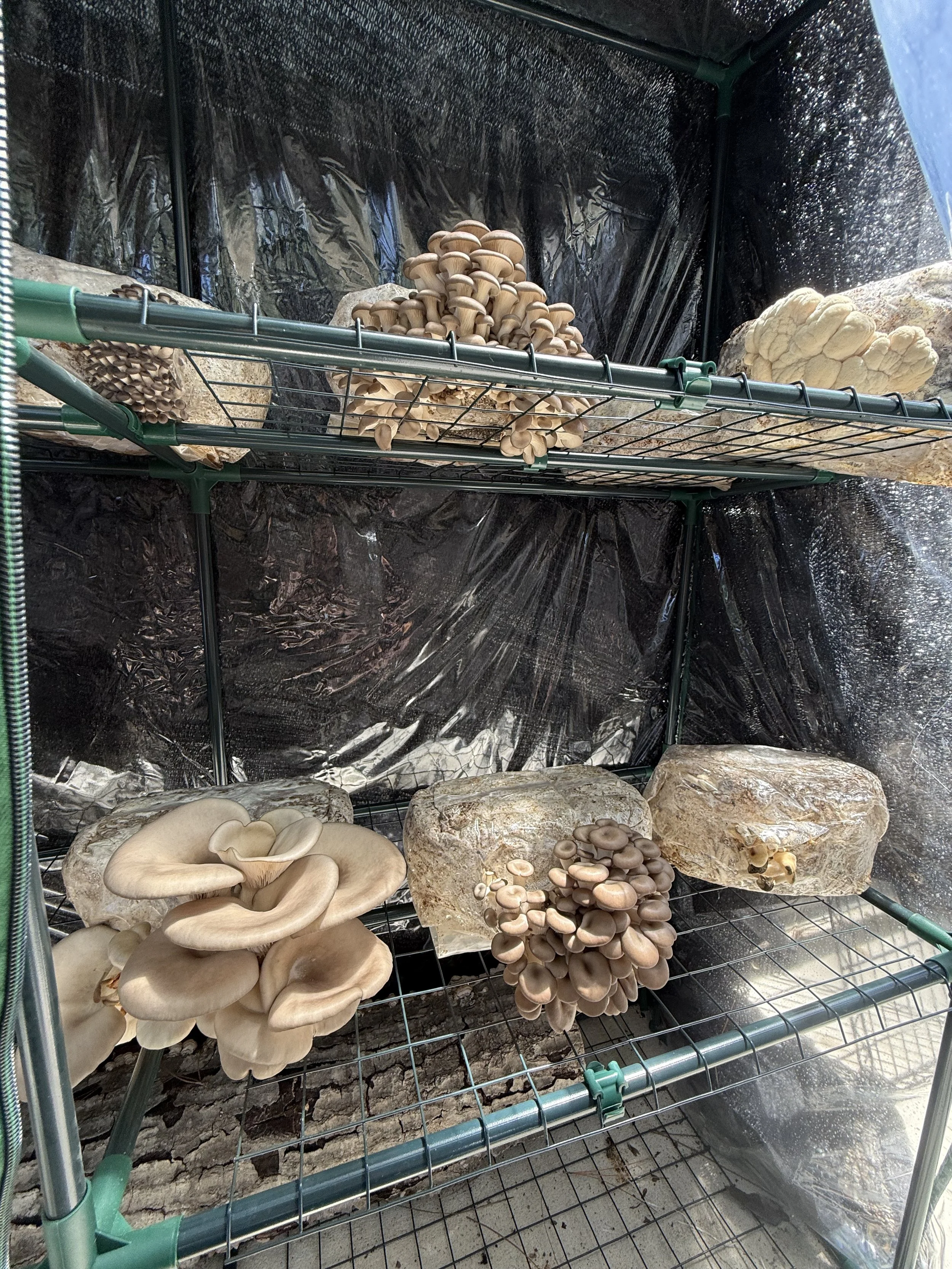
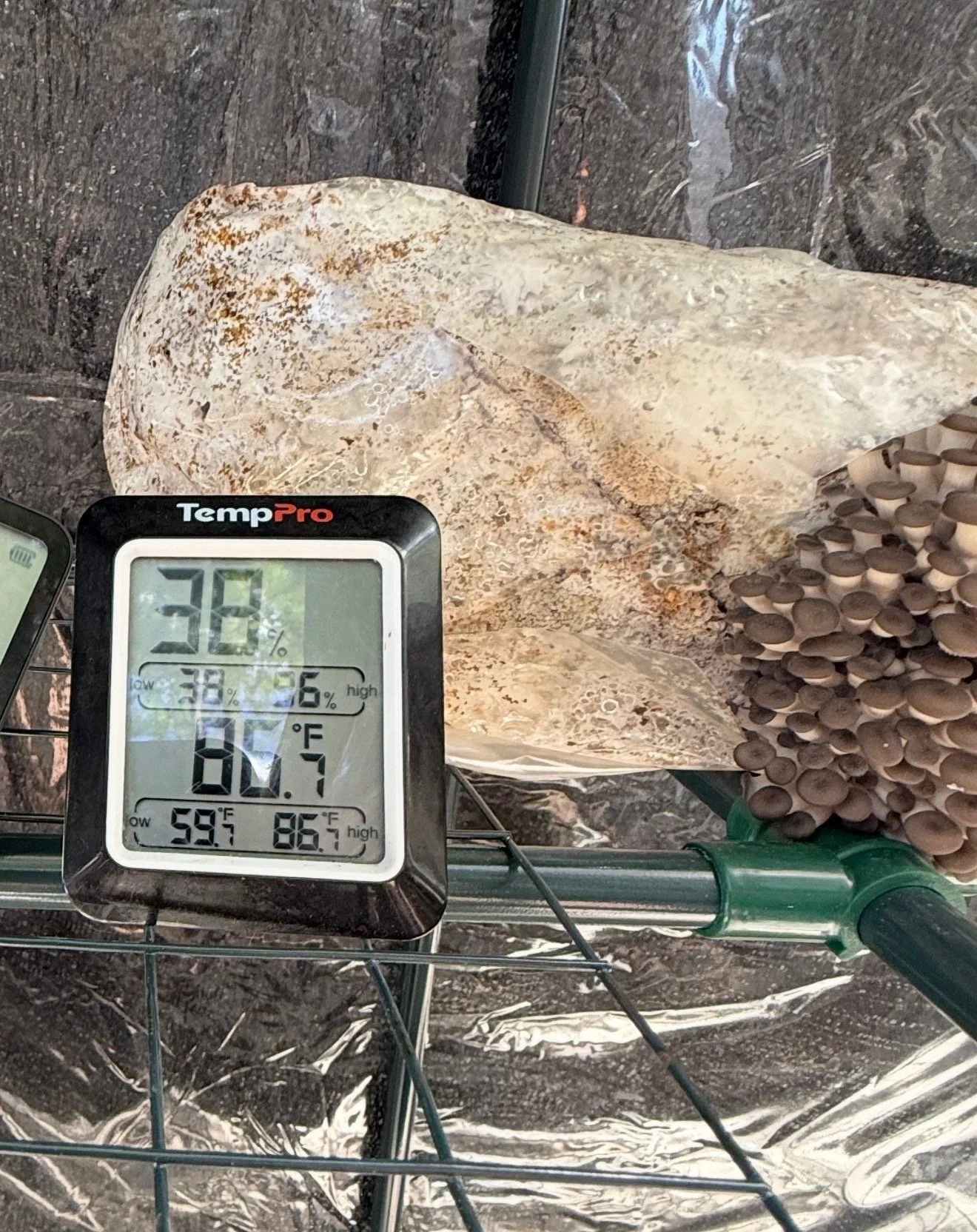
My tent has reached 90°F while humidity sits at ~40%. The inside of my blocks has reached 94°F? This isn’t how the books tell you to fruit, and for reasons of consistency I get it. BUT just because you don’t have perfect conditions, doesn’t mean you can’t grow mushrooms.
I get it, every guide tells you the same thing — keep it cool, keep it humid, 90°F will kill your pins. Then you watch a flush of oysters push out of a block sitting in a tent at over 90°F and wonder what you missed. Here's the part nobody explains.
The Standard Advice (And Why It's Incomplete)
Search "mushroom fruiting conditions" and you'll find the same chart copy-pasted across a hundred forums and grow guides. Pleurotus ostreatus: 60–75°F, 85–95% relative humidity. Hericium erinaceus: 55–75°F, high humidity essential. These aren't wrong, they reflect real published optimal. But they're not the full picture, and treating them as hard limits is where a lot of people, especially in subtropical climates, get stuck.
The confusion comes from collapsing two different systems into one number: ambient air conditions vs. substrate-level conditions. Most of the parameters you read were designed for commercial climate-controlled production rooms. They are not necessarily what the fungus is experiencing at the surface of your block. Once you understand the difference, fruiting at 90°F in a tent goes from "miracle" to "expected."
This is not to say that cold weather species like Freckled Chestnuts will willingly fruit at 90°F when they already hesitate at 65°F, but let’s not think of the temperature and conditions as a hard limit/control.
The core idea
Fruiting bodies form at the substrate surface — not in the air. Ambient temp and RH set the boundary conditions, but substrate moisture content, surface evaporation rate, and mycelial metabolic activity are what the fungus actually responds to. Those are not the same thing as what your hygrometer reads on the far side of the tent.
What "Humidity" Actually Means for a Fruiting Block
Here's what gets glossed over: a fully colonized block sitting at 60–65% substrate moisture is a reservoir. There's a significant volume of water bound into that substrate matrix. The primordium forming at the surface isn't "breathing" ambient RH as its primary moisture source — it's pulling water up through the mycelial network from depth.
Ambient humidity matters because it controls the evaporation rate at the block surface. High RH slows evaporation and keeps that surface moist long enough for pins to develop. Low RH speeds evaporation up. If the surface dries faster than the mycelium can resupply water from the interior, those pins abort. Simple as that.
So the question isn't just "what's the RH in my tent?" It's: can this substrate maintain surface moisture under these evaporative conditions? A well-hydrated block with a dense mycelial rind in a partially enclosed space has way more buffer than most people give it credit for. A dried-out, exhausted block sitting in a draft has none. Same ambient conditions — completely different outcomes.
Temperature: Range vs. Optimum vs. Tolerance
The scientific literature makes a distinction that popular cultivation guides do not: optimum, range, and tolerance are three different things. The "optimal" temperature is the peak of a performance curve, not the edge of a cliff. Fruiting doesn't stop at 76°F because somebody said the optimum is 70°F.
Worth internalizing
Mycelial growth operates over a wider temperature range than fruiting does — but fruiting also operates over a wider range than what's commonly quoted. The numbers you see in hobby guides are strain-specific optima from commercial production contexts, usually in 65°F grow rooms. They're not universal.
What almost never gets mentioned in popular content is the strain component. Commercial oyster cultivars were selected for cool-room production. Tropical and subtropical ecotypes of the same species have completely different fruiting windows. This isn't a minor thing, it's the whole game we play as Southern growers. This is why bio-proespecting, wild genetics and working with unknowns can be so valuable. They can be the ones who thrive in your conditions because that’s what nature in your local area bred them to do!
The question isn't whether mushrooms can fruit in the heat.
It's whether you're growing the right strain for your climate. Not all Blue Oysters are the same, Not all Hericiums are the same, NOT ALL MUSHROOMS ARE THE SAME.
What's Actually Happening in My Outdoor Tent
Let me be direct about what's going on in my poly tent setup here in Jacksonville in July. The tent walls trap humidity generated by the block itself — water evaporating off a colonized substrate at 65% moisture creates a localized high-humidity microclimate right around the surface. The air reading 50% RH on a probe eight inches away is not what the pins are experiencing. The boundary layer at the colonized surface is significantly higher. You're building a saturated zone around the block face whether you realize it or not. This is part of the Humidity/FAE balance. Too much of one, and the other is out of wack.
Second: substrate moisture, not air moisture, is keeping those pins alive long enough to develop. A well-hydrated block with a mature mycelial network is actively moving water to the surface as evaporation occurs. This is just capillary action through hyphal networks — same physics that moves water through soil and wood. As long as evaporation doesn't outpace supply from the block interior, the pins survive. Wetter blocks can also lead to more bacterial contamination. It can be tight rope walk in the lab to keep things sterile and healthy with the added moisture. A little goes a long ways, don’t saturate.
Third: the block surface during active fruiting is often cooler than ambient air temperature. Evaporative cooling is real. A moist surface evaporating into warm, drier air loses heat in the process. So the "94°F tent" temperature may not be what's happening at the surface where it actually matters.
Where extreme heat actually causes problems
None of this means temperature is irrelevant. Real heat damage shows up through two failure modes. The first is substrate desiccation — the block dries out faster than the mycelium can resupply water from depth, and pins abort or the surface mycelium dies back. This is by far the more common failure in outdoor subtropical setups, and the fix is substrate management: proper initial hydration, misting the tent walls and floor (not the block face directly), and managing airflow to get exchange without creating desiccating drafts.
The second failure mode is enzymatic denaturation — sustained temperatures high enough that the mycelium's cellular machinery begins to break down faster than it can be replaced. This requires sustained core temps above roughly 95–104°F depending on species, held for hours, not just a hot afternoon spike. A shaded, vented poly tent in Florida usually doesn't get there even in August. Shade is doing serious work. Direct sun is a completely different situation — don't confuse the two.
CO₂ and Airflow: The Variable Nobody Talks About
There's a third variable that gets almost zero attention in popular content: CO₂ buildup. Fruiting bodies are far more sensitive to elevated CO₂ than mycelium is. Pleurotus mycelium can grow vigorously at CO₂ concentrations of 15–20% — but the fruiting bodies of the same species start distorting at just 600 ppm (0.06%). The characteristic long stems and suppressed caps that people blame on temperature or humidity problems? A lot of the time, it's CO₂.
In a tent setup, CO₂ management is actually more actionable than temperature management. Regular air exchanges — opening the tent to fresh air a few times a day — flushes accumulated CO₂ and can directly trigger or accelerate pinning. Commercial growers manipulate CO₂ and fresh air exchange specifically to initiate pin sets in climate-controlled rooms. You can replicate the same effect manually. No equipment needed.
Simple outdoor tent protocol
Open the tent for 5–10 minutes, 2–4 times per day. Fan briefly if you have one handy. Mist the interior walls and floor after venting to restore humidity — not the block face. This does more for consistent pinning than obsessing over the thermometer reading.
Strain Selection Is the Real Variable
Everything above builds toward a single point: the standard fruiting conditions you read online are strain-specific, not species-universal. The oyster you're probably growing came from stock selected for 65°F production rooms. It'll fruit in your tent at 85°F, but it may be slower, smaller, or less consistent than a warm-climate cultivar of the same species would be under identical conditions. That's NOT a failure of your setup, it's a mismatch between genetics and environment.
This is why sourcing genetics from cultivators who've selected for subtropical performance actually matters. A strain that's been pushed through generations under warm conditions has a different thermal performance curve than one maintained in a refrigerated lab. That's real, meaningful genetic adaptation — not marketing language.
At Swamp Fox Fungi, I prioritize warm-weather Pleurotus strains — including Pink Oyster, Florida Oyster, and Phoenix Oyster — and work with Hericium genetics that push toward the upper end of the fruiting window. I track environmental data because Florida cultivators need Florida-validated data. The parameters published for a commercial facility in Pennsylvania are not your parameters.
The Bottom Line
Fruiting at 90°F in a tent isn't luck, and it's not proof that conditions don't matter. It's the result of overlapping factors working together: substrate moisture reserves that buffer against ambient dryness, a microclimate at the block surface that exceeds your probe reading, evaporative cooling at the fruiting face, appropriate strain selection, and CO₂ management through regular ventilation.
The "rules" of mushroom cultivation are useful starting points. They are not physical laws. Every one of them was derived under specific conditions with specific strains, and most of the commonly cited numbers come from temperate commercial contexts that have nothing to do with what you're doing outside in Northeast Florida.
Understand the mechanisms. Manage what you actually can. Grow strains adapted to your climate. Measure your own results. That's the practice. At the end of the day remember Mushrooms WANT to grow, you just have to give them the chance to do so!